Intel “DZ77GA-70K” Z77 Ivy Bridge motherboard pictured

As we know from the last couple of generations of Intel chipsets, Intel likes to make its own motherboards. Z77 will bring no exceptions, The Intel DZ77FA-70K is an LGA 1155 Z77 based motherboard.

CES 2012 Gaming Case Line-up

Going by Thermaltake's official spec sheet, the company has packed a powerful cooling system into an otherwise aesthetically superior case.

Asrock Z77 Extreme6 Socket 1155 Motherboard

Well the time has come. It is like Christmas time for many. Santa has delivered a brand new toy. In this case it is Christmas in April. Santa is Intel. And the elves are every motherboard manufacturer on the planet. The gifts contain motherboards with the brand new Panther Point Z77 chipset. Definitely just what the kiddies have been waiting for..

G.SKILL Memory Delivers the Fastest DDR3 Frequency Ever!

On 27th February 2012, the highest DDR3 memory frequency record was smashed again by the well-known Swiss overclocker, Christian Ney. Using G.SKILL extreme RipjawsZ memory kit, Christian Ney has achieved the astonishing score of DDR3 3736MHz with 4GB high capacity memory stick.

Asus P8Z77-V Deluxe Intel Ivy Bridge Motherboard Starts Selling in China

With one month to go until the official release of the Intel 7-series chipset family, a Chinese online store has listed Asus’ upcoming P8Z77-V Deluxe motherboard for Ivy Bridge processors with pricing being set at 2,499 RMB ($396 US).

Showing posts with label Ultrabook. Show all posts

Wednesday, August 01, 2012

Intel's 40 Touchscreen Ultrabooks in Pipeline

Intel's Ultrabook Symposium starts tomorrow in Taipei, but Netbook News have sat down with Navin Shenoy, Vice President of Intel Architecture Group and General Manager of Mobile Client Platform before the event starts, to talk about various topics before the event itself.

Shenoy has confirmed that there are 140 Ultrabook designs, with only 35 of these being seen by the public. As of next month, we should expect sub-$700 Ultrabooks, across the Ultrabook board, with more than one model. One of the biggest nuggets of information here is that there are set to be 40 Windows 8-based Ultrabooks with Touch launching in Q4 of this year.

This means before the end of this year, and the end of Mayan long-count calender (and all the doom associated with it), Intel are Microsoft (and various partners) are set to unleash 40 Ultrabooks with touch screens, which is exciting news. Intel's fourth-generation Core processor, Haswell, is destined for the 22nm process, and will be the first System-on-Chip (SoC) for PC. Shenoy pointed out that the idle power consumption of Haswell will be 20 times less than Ivy Bridge, this in itself is an amazing achievement. Haswell is also said to not just be an incremental step forward, but a giant leap in performance.

I'm genuinely excited about the future of the PC, in this 'post-PC' world. I really want to get my hands on a 1080p (or above) touch-screen Ultrabook running Windows 8. Gimme, gimme, gimme.

Source: tweaktown.com

Monday, July 16, 2012

New Apple MacBook Air 13 Review

In the constant cycle of tablet and smartphone news, the seemingly minor upgrade to Apple’s MacBook Air barely made headlines. That’s not really surprising, especially after the announcement of the Retina ready MacBook Pro. A next generation Intel CPU and graphics processor, USB 3.0 ports, and more flash storage don’t sound all that impressive.

In reality, this iterative update makes the MacBook Air the perfect laptop.
Same on the outside, shiny on the inside

Generally considered the premier Ultrabook (though it’s not officially labeled one), the MacBook Air is an excellent laptop that offers a near-perfect balance of size and power. It remains the thinnest and lightest 13” and 11” Ultrabook on the market.

I liked last year’s 13” model so much that I bought one, and still find the design and power superb for most personal and work applications. But what’s remarkable about the 2012 model — and this has nothing to do with Apple — is the performance boost gained solely from Intel’s latest Ivy Bridge chipset.

Last year’s MacBook Air ran on the then-new Sandy Bridge i5 processor, and my model was the top-of-the-line i7 with 4GB of RAM, priced at $1,800. The latest unit drops the price by $100 and offers the updated i5 or i7 at faster clock speeds while also doubling the RAM to 8GB. For less money, this year’s stock MacBook Air outperforms last year’s high-end model by 150% for nearly every application. (The 13-inch MacBook Air starts at $1,199 for a 1.8Ghz i5 processor and 4GB of RAM.)

Aside from the internal components, little has actually changed with the MBA. It uses the same heat dissipation techniques, the same basic architecture, the same display, and the same keyboard. There are a few differences, like improved viewing angles and increased brightness on the glossy 1440 by 900 display, as well as better color accuracy, something the 2011 model has serious trouble with. The keys are also slightly elevated for a deeper feeling keyboard, which is more comfortable to type with. Put the two models together however and anyone would have trouble knowing which was newer.

Improved enough to all but eliminate the problems

Stress the laptops, however, and there’s a world of difference. Pull up 20-30 YouTube clips; try streaming several bandwidth- and processor-intensive videos; run intensive applications like Adobe Photoshop with dozens of photos; boot capable games like Half-Life 2 or Flash-hungry titles like The Binding of Isaac…and the 2011 model’s fan will scream bloody Mary, the left side of the keyboard will heat up to around 100°F, and you’ll need headphones and a hard surface to keep going. The fan gets extremely loud and the keyboard gets way too hot. On the 2012 MBA the same thing can happen, but it rarely does.

That is to say, the overheating and loud fan hasn’t been fixed. This newer model is susceptible to both. With enough stress the left side of the unibody shell will overheat and become uncomfortable to type on, especially if you’re out in the sun. The fan can still stir up a hailstorm of noise. But thanks to the improved performance of Ivy Bridge, it’s nearly impossible to run enough everyday applications to stress the Air to that point. Except for intensive games like Half-Life 2, the 2012 MBA remained calm, cool, and pleasant to use. No matter how many browser tabs, office applications, or how much media you have running, the MacBook Air performs flawlessly.

Using the new Ivy Bridge chipset has another exceptional benefit from the higher performance: battery life is greatly improved. On the 2011 MBA battery life ranged from 4-7 hours, and usually closer to the lower side of that if running streaming video or stressful applications. That is boosted to 5.5-8 hours on the newer MBA, which is a remarkable upgrade for an identical 50-watt-hour battery. And because heat is rarely a problem, I averaged closer to seven hours of battery life per charge. (Protip: Use an extension like FlashBlock to disable Flash on any MacBook Air model for a big bump in battery life.)
The perfect ultrabook

In so many ways, the latest MacBook Air is a dream come true for anyone interested in upgrading to a thin, light, and still powerful laptop. Better performance, an improved display and keyboard, greatly improved battery life and thermals because of the performance boost…all for $100 less than last year’s model. Throw in USB 3.0 and the laptop is officially future-proof.

Products like the MacBook Air 13” (2012) make iterative updates like internal components so much more pertinent than evolutionary upgrades. The only downside? People who purchased last year’s model will want to upgrade because the performance boost makes all the difference in the world. If you barely stress the 2011 model now, then hold fast. But if you find that your MacBook Air screams like a banshee and has the average lifespan of a fruit fly, upgrading will be costly, but worthwhile.

Source: venturebeat.com

Saturday, June 23, 2012

With Ivy Bridge & Nvidia Kepler: Acer Releases Aspire Timeline M5 Ultrabooks

With Ivy Bridge & Nvidia Kepler: Acer Releases Aspire Timeline Ultra M5 Ultrabooks Acer is one of companies that decided to answer the call of users for usable ultrabooks with high-quality graphics. Regardless of using Sandy or Ivy Bridge processors, the integrated graphics inside those processors simply cannot satisfy all the contemporary computing demands.

During the GeForce Editor's Day 2012, held in San Francisco while Game Developer's Conference was in full swing, NVIDIA briefed journalists about the GK104 which we know as the GeForce GTX 680 and about GK107, the chip that brought GeForce to Ultrabooks. We received an Acer Timeline Ultra M3 series, which paired a Core i7 Sandy Bridge processor with a GK107 i.e. GeForce GT 640M 1GB. Unfortunately for consumers in the western markets, this ultrabook never left Asia. Acer planned on bringing the product to U.S. and EMEA markets, but the demand for the product was so strong that it was sold out in Asia-Pacific alone.

To satisfy the demand of Western markets, Acer waited on Intel's delayed release of 22nm Ivy Bridge processors and just announced the Aspire Timeline Ultra M5. The Ultra M5 ultrabooks are even slimmer and lighter than the previous generation, while keeping all the features of the M3.

The laptops are now just 0.81 inches thin (20.1mm), weighing just 4.3 pounds (1.95 kg). This package brings you a declared eight hours of autonomy, even though our experiences varied from three hours of gameplay to nine hours of video playback and productivity work of over 12 hours in a plane, working with Wi-Fi switched off. We like the fact that the notebook combines aluminum top with a plastic case, meaning the price of this Ultrabook will beat a lot of competing, all-aluminum or all-magnesium based products.

The company offers several technologies to prolong the battery life, such as a 20GB SSD that quickly restores your computer to full speed, unless you chose for a 128 or 256GB SSD drive option. One of things press releases often forget to write about is the Always Connect Wi-Fi from Acer, where the Wi-Fi connection is restored as you are typing your windows password.


According to the company, the laptops are powered by Sandy Bridge-based Core i3 and Ivy Bridge based Core i5 and i7 processors, NVIDIA GeForce Kepler graphics (GT 640M 1GB and 2GB), at least 500GB HDD with afore mentioned 20GB quick-boot SSD. Intel's Anti-theft technology is switched on by default, thus is someone steals your precious data, you can remotely brick the device.

One of things that we like is the addition of a second USB 3.0 port, which means that this Ultrabook ships with two USB 3.0 ports and a single 2.0 port. Both USB 3.0 ports are quick-charging ones (5V 1A), which means you can charge your phone, tablet, digital camera - all while using a single power outlet.

For me personally, one of key features of a notebook is a good quality keyboard and Acer is for some reason, traditionally more comfortable to type on than on HP or Dell, for example (subjective experience, yours may vary), and M5 brings LED backlit as well (finally).


The M5 is available in 14" and 15.6" screen sizes with prices starting at $679.99, going all the way to $829.99. Naturally, depending on a retailer/e-tailer, you should be able to upgrade the product with even higher performing parts, such as above mentioned SSDs, more memory (4GB DDR3-1333 comes as standard).

Source: Brightsideofnews.com

Friday, June 22, 2012

Ivy Bridge Asus Zenbook Prime Now Available On Amazon

ASUS' latest get it while it's hot Zenbook Prime has hit the servers of Amazon, where you can grab one while they're in stock for just $1,149. What does $1,149 get you? Well, you'll get an Intel Ivy Bridge-based Core i5 processor, 13.3-inch 1080p IPS display, and an SSD by default.

Without so much as a peep (or a tweet), Asus' next-gen Ultrabook, the Zenbook Prime, has gone on sale on Amazon.

The Asus ZenBook Prime UX31A has a similar design as the original Zenbook, but features an updated Ivy Bridge processor, backlit keyboard and a full-HD IPS panel. It also has 4GB of RAM and a 128GB SSD, which makes it almost identical to the 13.3-inch MacBook Air, but US$50 cheaper--the CPU on the Air is 100MHz faster.

Asus also has the Zenbook UX32VD, which comes with Nvidia discrete graphics for those who demand a slightly higher level of graphics performance. It's also available now on Amazon for US$1,299.

If you're looking for a Windows laptop with a high-resolution screen, the 13.3-inch Asus Zenbook Prime is definitely a contender. Although its 1,920 x 1,080-pixel screen doesn't quite match the Retina display on the new MacBook Pro, it's probably the best alternative in the market currently--unless you can afford a Sony Vaio Z.

Unfortunately, Amazon only ships this laptop to locations within the US. According to Asus Singapore, the Zenbook Prime will only be available in Singapore from August. Residents in Singapore who wish to get it earlier can try looking for it in Malaysia, where it is expected to be available sometime next month.

Source: Cnet.com

Wednesday, June 20, 2012

Acer Reveal Ivy Bridge, Aspire Timeline Ultra M5 Ultrabook With Nvidia Graphics

The parade of Ultrabooks marches on with Acer’s announcement of the new Aspire Timeline Ultra M5 lineup. Three new models offer no killer features, but do include — in the case of the two higher-priced notebooks — Intel Ivy Bridge processors and Nvidia graphics and are a mere 0.81 inches thick.

Starting at $679.99, the 4.3-pound M5-481T-6670 features a 14-inch LED-backlit 1,366×768 screen, 1.5GHz Core i3-2377M Sandy Bridge Processor and 6GB of RAM. An additional $80 nets you the M5-481TG-6814, which includes the same screen but also packs the 2.6GHz Core i5-3317U Ivy Bridge CPU and GeForce GT640M LE graphics. You do, however, only get 4GB of RAM.

The $829.99 M5-581TG-6666 bumps the screen size up to 15.6 inches (though with the same resolution) while keeping the same Ivy Bridge processor and GeForce graphics as the M5-481TG-6814. (You do get 6GB of RAM, however.) All three M5 systems include 500GB hard drives, 20GB solid state drives for quicker boot-ups (using the Acer Green Instant On feature), a DVD drive, and both Intel and Acer anti-theft technology. Acer claims battery life up to 8 hours thanks to the M5’s PowerSmart long-life battery pack.

While the Aspire Timeline Ultra M5 notebooks won’t wow you like the HP Envy Spectre, they continue the Ultrabook’s path toward becoming the mainstream laptop platform, which becomes important as back-to-school shopping kicks off soon.

Source: Zdnet.com

Wednesday, June 06, 2012

Toshiba Portege Z930 Intel Ivy Bridge Ultrabook

Toshiba Portege Z930 Intel Ivy Bridge UltrabookToshiba is now shipping the Portege Z930, a 2.5-pound Ultrabook with Intel Ivy Bridge processors, Tivoli technology from IBM and hardcore business features like a fingerprint reader.

Toshiba introduced the Portege Z930 Ultrabook and R930, R940 and R950 ultra portables June 5, all running Intel “Ivy Bridge” processors. Lest the machines risk being lost in the dozens upon dozens of new machines to run the 3rd-generation processors, Intel executives have said that more than 100 Ultrabooks have been designed around them. Toshiba has paired them with a second technology of note, a Smart Client Manager, powered by Tivoli from IBM.

The Manager puts an emphasis on three areas: power management, patch management and security.

“Those three things are very, very important when you’re looking at business notebooks,” Cindy Zwerling, Toshiba’s B2B Product Marketing Manager told eWEEK.

With the Manager, if people leave machines on over the weekend, an IT manager can adjust monitor power consumption for better energy efficiency gains. If a PC is stolen, IT has the ability to lock itself out of the network. And, from a single console, IT can control the deployment of patches, resolve problems from previously applied patches and provide up-to-date patch visibility. It’s Toshiba’s first venture with something from IBM, said Zwerling, and it’s on all four new notebooks, which are now shipping.

“What can we say that no one else can? Toshiba owns the entire process, from designing to manufacturing. We don’t ODM anything.”

Because it controls the process, she continued, “the end result is durable, high-quality PCS with some of the lowest failure rates in the industry.”

Still another distinction is that Toshiba calls the Portege Z930 the world’s lightest 13-inch Ultrabook. It weighs less than 2.5 pounds, measures 0.63-inches thick, offers up to eight hours of battery life and supports up to an Intel Core i7 processor with vPro and AMT technology.

Its solid-state drive makes it particularly responsive. There’s a “full complement” of ports, according to Toshiba, as well as a fingerprint reader and a solid, travel-ready case that includes a magnesium alloy casing along with a reinforced honeycomb rib design for shock absorption and increased rigidity.

An Ultrabook with a fingerprint reader, AMT and TPM? Reviewing the Z930’s specs, Zwerling insists, “No one has the offering that we have in this notebook.”

Pricing will start at $1,249.

Toshiba calls the Portege R930: world’s lightest 13.3-inch full performance ultraportable business laptop with an integrated DVD drive. An inch thin and 3 pounds, it supports up to an Intel Core i7 full-voltage processor and comes with two USB 3.0 ports, Bluetooth 3.0 and can be configured with a hard storage disk or solid-state drive.

Pricing starts at $1,399.

Rounding out Toshiba’s new lineup are the Tecra R940 and R950, machines weighing less than 4.5 pounds, measuring an inch thick and featuring LED-backlit widescreen HD displays—14- and 15.6-inches, respectively.

Both offer an Intel Core i5 or i7 processor, a bump in memory and graphics over previous models and a 2-megapixel HD Webcam—something Zwerling says customers have asked for. Spill-resistant keyboards, a fingerprint reader and Toshiba Sleep & Charge technology round out the features for this model.

Pricing starts at $1,199 for the R940 and $1,179 for the R950.

Source: Eweek

Tuesday, May 29, 2012

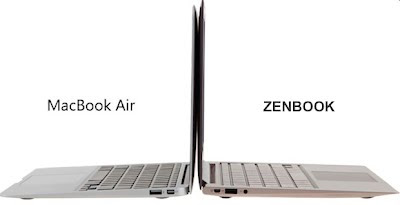
Apple MacBook Air Vs. Asus Zenbook Prime: Battle of Ivy Bridge-Powered Notebooks

Apple MacBook Air Vs. Asus Zenbook Prime: Battle of Ivy Bridge-Powered NotebooksNotebook computers have been attracting a fair amount of press in recent weeks, thanks largely to Apple’s new MacBook Pro, which is likely to be announced next month. However, the MacBook Air line is likely to undergo some changes, as is one of its top rivals – Asus’ Zenbook series of ultrabooks.

Some of the key features to be found on the new 13-inch Asus Zenbook Prime UX31A include a 1920 x 1080 in-plane switching HD display, backlit keyboard and solid-state drive options of 128 GB and 256 GB. Also expected on Asus’ new ultrabook is a revamped audio system courtesy of Bang and Olufsen and a new wireless network card that promises faster-than-ever WiFi connection speeds.

The aforementioned storage units both run on 6G SATA 3 speeds and most are expecting great things out of the HD matte display. The Asus Zenbook Prime reportedly weighs just 3 pounds, giving it an ever-so-slight edge over the current MacBook Air.

Apple, on the other hand, has long been mooting a price reduction for the new MacBook Air, which is likely due in the third quarter of the year. Tech and business blog site Digitimes reported that Apple might reduce the price of the MacBook Air from $999 to $799, a significant price reduction but probably timely, given Intel’s emphasis on the ultrabook market.

The new MacBook Air will likely boast its own improved display, thanks to Retina Display technology. However, not much else is known about this device at this point.

It will be an interesting battle of ultrabooks, though we may need a few more weeks before we glean more information on both devices, particularly the new MacBook Air.


Source: Easternmorningherald

Sunday, May 20, 2012

Intel To Support Cheap Ultrabooks With Low-Cost Celerons

Intel To Support Cheap Ultrabooks With Low-Cost CeleronsIntel may be reacting to criticism that its processors are simply too expensive to support the lower price tags of Ultrabooks.

According to Digitimes, the company will soon be offering two ultra-low voltage Celerons that could be used as CPUs for cheaper compact notebooks. The Celeron ULV 877 and 807 will reportedly be sold for $86 and $70 respectively.

Meanwhile, Intel is planning the second wave of Ivy Bridge processors, set to land on June 3, according to Digitimes. The new lineup will include the quad-core CPUs Core i5-3570, i5-3470, i5-3570S, and i5-3475S for desktop applications with prices ranging from $184 to $205.

There will be one new dual-core desktop chip (i5-3470T, $184), two new notebook CPUs (i7-3520M, i5-3360M and i5-3320M for $346, $266 and $225, respectively), as well as the Core i7-3367M and i5-3427M for Ultrabooks ($346 and $225).


Sourec: Tomshardware

Wednesday, May 16, 2012

Lenovo Introduces Fleet of New Ivy Bridge ThinkPads, Including 'Thinnest Ultrabook in the World' X1 Carbon

Lenovo Tuesday officially announced its new portfolio of business-friendly ThinkPad laptops, IdeaPad Ultrabooks, and IdeaPad multimedia laptops. Come June, it'll be raining Lenovo ThinkPads and IdeaPads.


We got a peek at many of these refreshed laptops--except for the ThinkPad X1 Carbon--earlier this year at CES, but now Lenovo has revealed pricing and other details. The new line has been refreshed not just to include the latest Intel Ivy Bridge processors, but with other significant improvements as well. For example, the new ThinkPad X, T, and L series laptops will feature optional HD+ (1600 by 900 pixel resolution) displays.


The new multimedia IdeaPad Y series laptops will offer the latest Nvidia Kepler graphics. And the ThinkPad X1 Carbon Ultrabook has been bumped up in screen size from 13 inches to 14 inches, with a new 1600 by 900 pixel resolution. These new models also sport Lenovo's revamped keyboard. The new keyboard is more attractive than the ThinkPad keyboards of yore, and is designed to be more precise. Starting prices range from $399 for the IdeaPad G Series to $1529 for the ThinkPad W530 mobile workstation.


Nine New ThinkPads
There are almost too many new Lenovo laptops to mention, but here are the highlights:


Ultraportables:
ThinkPad X230 and X230t: 12.5-inch ultraportables weighing less than 3 pounds, with up to 24 hours of battery life (with optional battery slice) and an IPS display for richer colors and better viewing angles. The X230t is the convertible tablet PC version. Starting prices: $1179 for the X230, $1479 if you want that touchscreen.


Mid-size T Series:


ThinkPad T430, T430s, and T530: 14-inch and 15-inch thin-and-light laptops. Lenovo says the T430s is the lightest 14-inch ThinkPad with both docking and vPro (Intel's laptop management and security technology). Currently, the T420s weighs 3.68 pounds—almost a pound less than the 4.6-pound T420.


Shaving the weight off, however, will cost you: The T430s starts at $1399 versus $879 for the T430. If you want a bigger version of the T430, Lenovo offers the T530, with a 15-inch full HD display. You can take one of these laptops on a long distance round trip and never worry about battery life; the laptops are rated for up to 32.5 hours of battery life with a battery slice.


Budget Thinkpads:


ThinkPad L430 and L530: Affordable business laptops starting at $879. These "value" laptops are rated for up to 9.5 hours of battery life and have optional discrete graphics cards. Previous L Series models started at over $1000, so these refreshed laptops will save you some money.


Professional Ultrabook:


ThinkPad X1 Carbon: claimed to be the lightest 14-inch Ultrabook, weighing just under 3 pounds. Boast-worthy features include the 1600-by-900-pixel display, backlit keyboard, and 0.71-inch thickness. We can thank the carbon-fiber construction for the super light weight.


Eight New IdeaPads 
That's a lot of laptop refreshes--even more than HP's recent announcement of several new laptops. But wait, there's more! Lenovo is also refreshing the Y, G, and Z series.


Gaming laptops:
IdeaPad Y480 and Y580: 14- and 15-inch laptops for gamers. Both come with Nvidia 600 series (Kepler) graphics cards, JBL speakers, and an optical drive (TV tuner and WiDi are optional). They're pretty snazzy looking too, with brushed metal casing. The larger Y580 offers a full HD 1920 by 1080 display.
The Y series start at an affordable (for a gaming laptop) $899.
Entry-Level IdeaPads:
G480, G580, and G780: the most affordable of the new Lenovo laptops, starting at $399. The G Series laptops come in 14-, 15.6-, and 17.3-inch sizes (respectively). The base models will be upgradable to up to 8GB of memory, 1TB of hard drive storage, an Intel Core i7 processor, and Nvidia GT630M graphics. (Aside from the 8GB max memory, the other optional upgrades exceed Lenovo's current G Series options.)
Everyday Multimedia:
IdeaPad Z380, Z480, and Z580: widescreen laptops starting at just $599. Lenovo's 13.3-, 14-, and 15.6-inch (respectively) multimedia laptops offer optional Blu-ray drives, colorful cases, and spec options that include Intel Core i7 processors and Nvidia graphics cards.
Can't wait to get an updated Lenovo laptop? These new laptops will be rolling out in May and June.
Source: Pcworld

Tuesday, May 15, 2012

Intel Ivy Bridge's New Rival Is AMD Trinity

AMD challenges Intel's upcoming Ivy Bridge processors, with an eye to powerful graphics and long battery life for ultrabook-like machines and laptops.


AMD released its Trinity chips Tuesday, its second generation A-series APU (accelerated processing units.) These low-power chips are intended for ultrabook-like laptops, traditional laptops, and some all-in-one desktops. Trinity offers better performance and lower power utilization than the previous AMD Llano family of chips. 


The new chip designs call for about 10% more transistors on a slightly larger die, using the same 32 nm manufacturing process as the previous family of chips known as Llano. However the new chip uses AMD's latest CPU core design, called Piledriver, which succeeds Bulldozer.


The chip also offers more and better graphics power (using AMD's Radeon technology.) In other words, Trinity is designed for speed and tuned for very high resolution displays. The added transistors and higher performance all on the same process might lead you to believe the chip will be power hungry, but AMD says it has tuned power management so that a 17 watt version of Trinity will outperform the 17 watt version of Llano by a 2:1 factor. AMD also showed charts showing that Trinity chips offer about the same or superior battery life versus Intel's existing i5 chips, which have been shipping since first quarter 2011.


Using various popular applications, AMD shows itself neck and neck with Intel in battery efficiency; however the comparison is with Intel Sandy Bridge chips rather than Intel's upcoming Ivy Bridge chips for ultrabooks, which are said by Intel to be a good bit more power efficient than Sandy Bridge. Whichever company's chip you choose, battery life is likely to be in the six to nine hour range for most laptop designs, which is a healthy improvement over what most of us are used to now. Much of what's new with Trinity has to do with better graphics support. While the gamers and movie watchers will have an obvious attraction to the better video, there are business applications too, including high definition video chats, and some applications for traders where multiscreen support and high-speed rendering are important. AMD says its new video technologies are already supported by IE, Firefox, Chrome, and Windows media player among others.


If you're a gamer, AMD says you'll notice 20 to 50% improvement over Intel's Ivy Bridge chips in performance, depending on the game and the resolution and quality.


The higher you have the game's video quality settings cranked up, the better AMD will perform, AMD says. (AMD is citing third party results for Ivy Bridge performance, so the tests are not precisely apples to apples.)


Along with improvements in video and core CPU, AMD's big add is to support ultrathin device form factors.


Can a mobile device be an Ultrabook if it doesn't have an Intel chip? Probably not, but it can sure look like one.


Source: informationweek

Friday, May 11, 2012

HP launches ultra-thin notebooks and ultrabooks like Apple’s MacBook Pro

HP launches ultra-thin notebooks and ultrabooks like Apple’s MacBook ProHP has launches Envy ultra-thin notebooks and Ultrabooks like Cupertino based Apple’s MacBook Pro

Leading computer maker Hewlett-Packard has announced a line of revamped laptops for the summer. The new HP computers include a few HP Envy models and a business friendly Ultrabook. HP is one of the prominent tech makers that develop advanced laptops and Ultrabooks with ultra-thin body and high performance processors. Of course, the just launched Intel’s third generation Ivy Bridge processors and the upcoming Windows 8 will be the major highlights of the new HP laptops and Ultrabooks. Here are some new HP portable computers.

HP Envy Ultrabook – 14-inch and 15.6-inch
HP is set to expand its Ultrabook line with two affordable models. The 14-inch HP Envy Ultrabook will start with $750 and the 15.6-inch Envy Ultrabook will start with $800 price mark. The machines may respectively be named HP Envy 4 and Envy 6. There have been reports about these products since April. As per the available details, the new Envy Ultrabooks will offer long battery life, i.e. up to 8 to 9 hours. The machines will show off great sound clarity thanks Dr Dre’s Beats Audio and better storage with the fast mSATA SSDs. Further details of the Envy Ultrabooks are not yet availed by HP. Possibly they may go for sales on May 9.

HP Envy Sleekbook
Not enough Envy laptops to choose from? You’ll also find a new thin laptop that HP has dubbed the Sleekbook. With a thickness of 0.8 inch and a weight of less than 4 pounds, this laptop could easily qualify as another Envy Ultrabook. But the Sleekbook does have a unique configuration of options and features, including optional discrete AMD graphics and a choice of black or red for the slip-resistant base. According to HP, the Sleekbook starts at $600 for the 15.6-inch model (available on June 20) and $700 for the 14-incher (available on May 9). The counterintuitive difference in prices reflects the fact that the laptop with the larger screen is configured with an AMD processor, while the one with the smaller screen has an Intel CPU.

HP EliteBook Folio 9470m: Business Ultrabook
HP is to launch yet another business Ultrabook. The new machine called the HP EliteBook Folio 9470m is a rich business-class notebook. It is larger than the company’s existing business Ultrabook, the Folio 13. The Folio 9470m is to come with a 14-inch display. However, it has only a thickness of 0.75-inch and weight of 3.5 pounds. The business friendly features of the Ultrabooks include VGA, Ethernet, Trusted Platform Module (TPM) data protection technology and an optional secondary six-cell slice battery. As per reports, HP will likely launch the HP EliteBook Folio 9470m in October this year. Price details of the Ultrabook are not available.

HP Envy Spectre XT
The Envy Spectre XT is a new addition to HP’s Spectre family. The new laptop is described as an ultra-stylish version of the series, which looks pretty sleek with its glass top. According to HP, the new XT notebook will come with an all-metal chassis, a thin bezel and a large display within its smaller 13.3-inch footprint. HP Envy Spectre XT features 0.57-inch thin body and it weighs at 3.07 pounds. The notebook will come with Intel Ivy Bridge, a backlit keypad, 128GB SSD and a powerful battery that can provide 7 hours life. The starting price for the Envy Spectre XT will be $1000 and it will be available in stores on June 3.

HP Envy Sleekbook
Envy Sleekbook is yet another brilliant member to the company’s sleek and powerful notebooks. The Envy Sleekbook, with a 0.8-inch body and 4-pound weight, is almost like HP’s Envy Ultrabook. But the machine will be different from the rest with a unique configuration of options and features. For example, it will get an optional discrete AMD GPU for increased graphical performance. The Sleekbook will have two models; the 15.6-inch and 14-inch. The first one will start at $600, whereas the latter one will have a starting price of $700. The expected release dates for the devices are respectively June 20 and May 9. The larger version of the Sleekbook is to sport an AMD processor, while the 14-inch version will have an Intel CPU.

Source: novnews


Tuesday, May 08, 2012

Samsung reveal media-focused Ivy Bridge laptops

Ultrabooks are all the rage, but when you need something with a little more capability, there’s nothing like a laptop that’s large and in charge. Breaking from their mostly thin-and-light lineup thus far this year, Samsung has revealed multiple entries into the Series 5 family under the 550 P label. These Ivy Bridge models come in 15 and 17-inch varieties, with a collection of media-focused optional features like Blu-ray drives and high-end discrete graphics cards.

In the UK the 15-inch versions will be given the model numbers NP550P5C-A02UK and NP550P5C-S03UK. Both have identical 1366×768 screens, 8GB of memory, DVD-RW drives and 5200mAh 6-cell batteries. The more expensive S03UK is equipped with an NVIDIA GT 650M graphics card. The 15-inchers have an admirable thickness of 1.11 inches. The 17-inch NP550P7C-S02UK steps things up with a Core i7 3610QM processor, a 12.3-inch 1600×900 screen, a Blu-ray drive and the GT 650M to boot.

All three models feature JBL speakers with a Mac Bass Boost subwoofer, promising better sound that the usual tinny laptop fare. Expansion options weren’t mentioned, but a shot of the laptop’s side reveals two USB 3.0 ports and HDMI-out. Storage options include hard drives up to 2TB, though Samsung is being mum on which models will get which drives. Samsung plans to launch the Series 5 550 P models in the UK later this month, though they haven’t said a peep on price thus far. There’s no word on other markets.

Source: Slashgear

2012 Macbook Air may battle Ivy Bridge Ultrabooks with price cut

2012 Macbook Air may battle Ivy Bridge Ultrabooks with price cutApple may not be talking about concerns over competition between their 13-inch Macbook Air and 2012 Ivy Bridge Ultrabooks, but that doesn't mean they are ignoring the threat either. In fact, Apple is taking it so seriously, there is already speculation that the next generation of Macbook Air's will emerge with a price cut.

"Apple's plans are reportedly to counter second-generation Ultrabooks, based on Intel's specifications for thin and light notebooks, which PC makers hope to price around $699," according to Apple Insider.

"If PC makers are unable to reach the $699 price point with their second-generation Ultrabooks, Apple could have a significant competitive advantage with an aggressive $799 price point for a new MacBook Air."

So, could Apple really be ready to think the unthinkable and cut the price of the next generation Macbook Air?

Ultrabooks have come a long way since their introduction behind the 2008 Macbook Air, and Ivy Bridge Ultrabooks could still pose a threat to the 2012 Macbook Air, even with a price cut.
There is a lot at stake for Intel this year. Their branding for the Ultrabook could shape the future of PC's as true performers, or give Apple yet another success story, proving they know how to eat the competition.

2012 is being touted as the Year of the Ultrabook. That means that in the world of laptops, Ultrabooks will either emerge as viable competitors, or Apple will corner the 13-inch laptop market and leave the 2012 Ultrabooks in the dust.

Portable computing has also become a battle of operating systems, with Apple boasting less susceptibility to internet viruses than PC's. But there is yet another factor working in Apple's favor. With the growing number of iPhones and iPads on the planet, compatibly could push some potential Ultrabook buyers toward the Macbook Air. Apple products would much rather 'talk' to other Apple products, thus making syncing between devices even more convenient.

Apple seems to be banking on their new strategy with their 13-inch line. In addition to rumors of a price cut for the next generation of Macbook Air's, orders for the 13-inch 2012 Macbook Pro are far exceeding 15-inch models, according to Digitimes, which suggest that Apple may be getting ready for a big push of their best-selling,13-inch Macbook Pro line as well.

If you follow the supply chain and production lines with Apple, it is easy to see their vision for the future, although tracking is not really required. Apple has made no secret of the fact that they want consumers to think of only one name when it comes to technology, and that name is Apple.


Source: Allvoices

Intel Ivy Bridge laptops: top laptops with Intel’s third gen chips

Intel Ivy Bridge laptops: top laptops with Intel’s third gen chipsLeading computer manufactures have announced new line of laptop s with Intel Ivy Bridge, Intel’s third gen chips

Chip maker behemoth Intel has just showcased some models of its third generation Core-i chips, codenamed the Ivy Bridge. The high performing and energy efficient chips are soon to appear in a set of advanced computers, laptops and Ultrabooks. For your information, Intel has already unveiled Ivy Bridge models like Core i7-3920XM, Core i7-3820QM, Core i7-3720QM, Core i7-3612QM and Core i7-3610QM. Other models will soon hit stores.

Anyway, many leading manufacturers have already launched their latest computers with the Ivy Bridge chips. Here we review a few laptops from a variety of computer makers, which are announced to get the Icy Bridge processors.

Dell Alienware M14x, M17x & M18x
Leading computer maker Dell has revamped its famous Alienware gaming laptop series with the Nvidia GeForce GTX 600 series graphics cards and Intel Ivy Bridge processors. Dell made the announcement soon after the release of Intel’s new chips. The new line of Alienware gaming laptops namely the M14x, M17x and M18x come with the Intel Ivy Bridge chips and also keep the AlienFX lighting and styling. The expected price for the Dell Alienware goes like $1099 for M14x, $1499 for M17x and $199 for M18x at $1999.

Acer V3 series
The Taiwan tech maker has announced two models of its V3 series with the new Ivy Bridge processors. The 14-inch and the 15.6-inch models come with 2.3GHz Core i7 quad-core chips, Nvidia GeForce GT 640M GPUS and 750GB HDD. The 14-inch version of the V3 series is to hit stores for $1,198.

Samsung Series 7 Gamer
Samsung Series 7 or Samsung Series NP700G7C is a thin 17.3-inch gaming laptop with Ivy Bridge processor and advanced Nvidia graphical card. The device will mount an Intel Core i7-3610QM processor, an Nvidia GeForce GTX 675M GPU, 16GB of memory and an amazing 1.5TB (7200 rpm) HDD and so on. Amazon is to sell this powerful gaming laptop for $1899.99.

Lenovo IdeaPad Y480 and ThinkPad Edge E430
The Chinese laptop maker has already announced a set of Ivy Bridge-based laptops including the much-touted IdeaPad Y480 and ThinkPad Edge E430. The IdeaPad, which will come with GeForce GT 640M GPU, is aimed at consumers; while the ThinkPad Edge with GeForce GT 630M is meant for business users. The devices will soon hit stores with the high performing Intel Ivy Bridge processors.

Asus G75VW and Asus G55VW
ASUSTeK’s G75VW and G55VW gaming laptops will also be in the list of first laptops to get the Ivy Bridge processors. The machines will be among the first laptops to get Nvidia Kepler graphics with the powerful GeForce GT 660M card. The laptops will mount standard Intel Core i7 3610QM processors. Asus is to sell the 17-inch 3D-capable G75 for $1499.99. The device will have 16GB of RAM and 750GB of HDD. An equally spec’ed 15.6-inch G55 will come for a price around $1449.

Origin EON11-S, EON15-S and EON17-S
Leading custom PC maker Origin has announced three models of laptops with the Ivy Bridge processors. The new models are the 15.6-inch EON15-S, the 17.3-inch EON17-S and the 11.6-inch EON11-S. All the models will come with Intel Ivy Bridge processors and Nvidia 650M or 675M GPUs. The EON11-S will come for $999, the EON15-S for $1561, and the EON17-S for $2541. Origin directly sells all the devices.

HP Pavilion DV6
HP’s Pavilion DV6 is to come with the Intel Ivy Bridge chips and advanced graphical processors. What is best with the device is that it the best option for a laptop with matte full-HD display. Certainly, it might be one of the first Ivy Bridge-based laptops from Hewlett-Packard.

MSI GT60MSI GT60 and GT70
MSI has also announced a pair of gaming laptops; the 15-inch GT60 and the 17.3-inch GT70 to come with Intel Core i7-3610QM processors and Nvidia’s GeForce GTX670M GPUs. The MSI laptops are to come with colorful bodies and Steelseries-designed keyboards with different backlighting modes and ultimate customization options. A whopping 32GB of RAM, SSD RAID configurations and other features will make the laptops outstanding. The GT60 is to be priced at $1499 and GT70 for $1549.99.


Source: Novnews

Monday, May 07, 2012

Sony Site Reveals Ivy Bridge Vaio T Series Ultrabook

Sony has started accepting pre-orders on a pair of new ultrabooks we talked about in the past, and specs on a new Ivy Bridge version have surfaced as well. Two of these machines are the Vaio T Series 11.6-inch and 13.3-inch machines. The pre-order ultrabooks are available at German retailers. Specs on base versions of the machines are available. The retailers promise two of the ultrabooks will be available to ship within two weeks. The specifications below come from the official Sony German website.

The new Ivy Bridge notebook is the SVT1311W1E. This ultrabook shows an Intel Core i5-3317U processor with Turbo Boost technology. The specifications listed 13.3-inch screen, 128 GB of SSD storage, and 4 GB of memory. The chipset is listed as the HM76 Express and the machine can support a maximum of 8 GB of RAM.

The machines listed on the Sony website include a silver 11.6-inch ultrabook model number SVT1111M1E. The machine has a Core i3-2367M 1.4 GHz processor. It can be fitted with 4 to 8 GB of memory, and storage options include a 120 GB SSD, 320 GB HDD with a 32 GB SSD or 500 GB HDD with an SSD cache. There are also 256 GB and 512 GB SSD options. The base price for this machine is right under €674.

The other machine is the 13.3-inch SVT1311C5E. This machine uses an Intel Core i3-2367M processor at 1.4 GHz and an unknown optional Core i7 processor is available. The computer has 4 GB of memory base and can be optioned with up to 8 GB. It also gets the same exact storage options as the 11.6-inch model. Pricing for this machine starts right under €799. Apparently, the links for pre-ordering on the European websites have been pulled at this time.

Source: Slashgear

Friday, May 04, 2012

Sony's first ultrabook, the Vaio T13 & T11

Sony's first ultrabook, the Vaio T13 & T11Sony is no stranger to thin, portable laptops. Take the company’s Vaio Z series laptop, a 13-inch device that’s just 0.66 inches thick and weighs only 2.57 pounds. While those specs make most of us think “ultrabook,” Sony on Wednesday revealed its first true, Intel-approved ultrabooks, the Vaio T series.

The irony? The 13-inch model in Sony’s new ultrabook line-up is a bit thicker and much heavier than the company’s existing super-thin Z series notebook. It’s a curious data point given device thinness and lightness is an ultrabook calling card. The new T13 weighs 1.6kg. That’s about 3.5 pounds — nearly a full pound heavier than the Vaio Z series notebook.

As for thinness, the T13 ultrabook is 17.8 mm, about 0.7 inches. That’s just a smidgen thicker than Sony’s 0.66-inch Z series notebook, but it’s still a noteworthy data point considering ultrabooks are supposed to own the thin-and-light crown.

Beyond this, the new Vaio T computers include what you’d expect in an ultrabook. The lineup features 11-inch and 13-inch models, the Vaio T11 and Vaio T13, respectively. The computers feature slick silver bodies made of magnesium and aluminum, and include HDMI and VGA ports, as well as SD/MMC card reader slots.

Sony’s 13-incher will come with 4GB of memory, a 1366×768 display, hybrid 320GB HDD and 32GB SSD storage, and Intel HD Graphics 3000. It promises up to nine hours of battery life, and an “any time” charger for your smartphone, allowing you to charge your phone even when the laptop is off, or in sleep mode.

The T Series specs aren’t mind-blowing, but they’re on par with ultrabooks currently on the market. But, unfortunately, what’s on the market right now will soon be outdated when Intel’s third-generation Ivy Bridge processors begin arriving in hardware. Sony’s specs show that the T Series ultrabooks will run Intel’s Core i3-2367M processor, a Sandy Bridge chip that will be eclipsed by Ivy Bridge.

It seems strange that Sony would announce and release its first ultrabook on the Sandy Bridge platform only months before we’re expecting to see Ivy Bridge ultrabooks. We reached out to Sony for comment, but received no response by press time.

The T11 and T13 will be available within the month in the European market, according to a Sony press release. There’s still no word on pricing or stateside availability.

Source: Wired

Thursday, May 03, 2012

Samsung Series 9 Ultrabooks to Get Ivy Bridge Update appears online

Samsung Series 9 Ultrabooks to Get Ivy Bridge Update appears online ...The thin and light Samsung Series 9 Ultrabooks will be upgraded to Intel’s Ivy Bridge.

The upcoming 15-inch laptop will sport a Core i5 3317U processor clocked at 1.7Ghz, according to a listing on Samsung’s site, but the company didn’t say when it would be available to buy, or for how much.

The new processor for the 15-inch Series 9 Ultrabook will work alongside an improved HD 4000 GPU (from HD 3000) and a HM75 Express chipset. The standard RAM gets bumped to 8GB (2 x 4GB). The storage for the updated Series 9 Ultrabooks remains at a 128GB solid-state drive and the display stays at a resolution of 1600 by 900 pixels.

The Samsung Series 9 laptops have received positive reviews so far, even though they feature yesterday’s chipsets. My colleague Sarah Jacobsson Purewal reviewed the current 15-inch model and found it to be an attractive machine given its slim profile and roomier screen compared to most Ultrabook offerings, which have 13-inch screens.

The average battery life in PCWorld’s test for the 15-inch model was just 7.5 hours, which is a notch above the 6.2 hours other Ultrabooks (with smaller screens) managed to perform.

A couple of other areas Samsung might want to look into are the sound system and the keyboard and touchpad for the Series 9, as those area were deemed disappointing in PCWorld’s review. The keys lack travel and have weak tactile feedback, which makes it difficult to type accurately over long periods of time. Although the trackpad is large and soft, the multitouch gestures were jerky and inaccurate, and the speakers worse than average.

Samsung didn’t say when the improved Series 9 Ultrabook would be available, or how much it would cost. But if the current model is any indication, expect the price tag to be around the $1,500 mark.

Source: PCworld

Wednesday, May 02, 2012

Intel Ivy Bridge TouchScreen Ultrabook

Intel Ivy Bridge TouchScreen UltrabookSince the announcement of the Apple iPad 3, I have been mulling over tablets and their use. This got me thinking about their pros, cons, and what other alternatives are available? Well after reading an article on engadget. I think I may have found my alternative choice. An Intel Ivy Bridge touchscreen Ultrabook.
That’s right a touchscreen laptop. This new device yet to be announced is basically a small thin Ultrabook with a touchscreen. This got me thinking why have a laptop and a separate tablet, when I could have both in one device. The Ultrabook would be considerable more powerful than a tablet.

Features

  • 13” touchscreen 1600×900 pixels
  • 1.5 GHz Intel Ivy Bridge
  • USB 3.0
  • SD card slots
  • HDMI port

As you can see by early specs this seems like a great device. Another pro would be the ergonomics of a laptop for working long term. Typing out reports on a tablet could get exhausting. Now add in the touchscreen capabilities of a tablet, such as pinch and zoom, and you have a a great feature set here.

It is too early to say if I could even attempt to edit on it without getting my hands on one first. However, the addition of USB 3.0 and HDMI means at the very least I could use it for offlining footage. This seems very promising right now. I think I may hold off on Apple iPad3 and wait too see what Intel has in store for us. We may even get a sneak peak at NAB in just a few weeks. I will be at NAB again this year, so hopefully I can get to see some of this technology up close and personal.

Check out the video below where you can see hands on with the Ultrabook.


Sunday, April 29, 2012

Intel Wants Touchscreen Ultrabooks, But Will They be Affordable?

Intel Wants Touchscreen Ultrabooks, But Will They be Affordable?Intel is showing off a reference design for touchscreen Ultrabooks this week, though PC makers are still struggling to make non-touch Ultrabooks affordable to the masses. It begs the question: If they build it, who can afford to buy it?

Engadget spotted the reference design at Intel's CeBIT booth. The thin and light laptop, powered by an Intel 1.5 GHz Ivy Bridge processor, had a 13.3-inch capacitive touchscreen with 1600-by-900 resolution, capable of 10-finger input.

Intel doesn't sell computers, of course. The reference design serves as a model for other PC makers to use when building their own laptops.

But those PC makers are already having trouble keeping prices down on existing Ultrabooks, which run on Sandy Bridge processors--the predecessor to Ivy Bridge--and lack touch screens. Speaking with The Verge, Acer's Christoph Pohlmann said even the current low-end price of Ultrabooks, around $799, is unsustainable.

Acer barely profits when someone buys a $799 Ultrabook, Pohlmann said. The low price is essentially a lure for the Ultrabook concept, but it's only worthwhile if some customers buy machines with better specs at higher profit margins. Pohlmann said this model is unlikely to last.

As Intel pushes touch screen Ultrabooks with Ivy Bridge processors, I have a feeling laptop makers will be looking forward to a price drop for Sandy Bridge more than the increased power efficiency and capabilities of the new processors. There's just not enough room for PC makers to compete at the high-end with Apple and with each other.

Intel also needs to release reference designs for convertible and modular laptops, not just traditional laptops with touchscreens tacked on. If an Ultrabook can turn into a tablet, it stands a better chance of doing well at higher prices, because consumers would be getting two machines in one. With the Windows 8 Consumer Preview available to the public, now's the time to get people exciting by showing what a two-in-one machine would look like.


Friday, April 27, 2012

Ivy Bridge ultrabooks coming in June

Ivy Bridge ultrabooks coming in June
Intel launched its third-generation Core family of processors this week. But all of the new Ivy Bridge chips available at launch are quad-core processors designed for desktop or high-end laptop computers. During yesterday’s launch event, Intel executives said dual-core ultrabook processors would be coming in a few months.
Ivy Bridge ultrabooks coming in June

Now Intel product manager Scott Pendrey has provided a slightly more specific date: June 5th.

Speaking to TechWorld, Pendrey said that’s when the first ultrabooks featuring Ivy Bridge processors would hit the market.

Not surprisingly, June 5th also happens to be the first day of the Computex 2012 trade show in Taiwan. It’s one of the biggest computer trade shows of the year, and it’s a place where PC makers start to show off products that will be available during the second half of the year.

In other words, it’s a pretty good place to launch a thin and light laptop featuring Intel’s latest processors. Ivy Bridge chips are expected to use about 20 percent less power than their predecessors while offering 20 percent better performance. The biggest gains will be in graphics performance, with Intel saying that some computers with Ivy Bridge graphics should be able to play modern 3D video games without a separate graphics card.

Ultrabooks are ultraportable laptops that tend to measure less than 0.7 inches thick, weigh less than 4 pounds, and feature either solid state disks or hard drives with solid state cache for a performance boost. They also all have Intel processors — because Intel trademarked the word ultrabook. If it doesn’t have an Intel CPU it’s not an ultrabook… although AMD has its own plans for the moderate-to-high performance ultralight laptop space.

Interestingly, Windows 8 Release Preview is also due out the first week of June. Laptops, tablets, and other devices preloaded with Windows 8 are expected to be available later this year.


Source: Liliputing