Intel “DZ77GA-70K” Z77 Ivy Bridge motherboard pictured

As we know from the last couple of generations of Intel chipsets, Intel likes to make its own motherboards. Z77 will bring no exceptions, The Intel DZ77FA-70K is an LGA 1155 Z77 based motherboard.

CES 2012 Gaming Case Line-up

Going by Thermaltake's official spec sheet, the company has packed a powerful cooling system into an otherwise aesthetically superior case.

Asrock Z77 Extreme6 Socket 1155 Motherboard

Well the time has come. It is like Christmas time for many. Santa has delivered a brand new toy. In this case it is Christmas in April. Santa is Intel. And the elves are every motherboard manufacturer on the planet. The gifts contain motherboards with the brand new Panther Point Z77 chipset. Definitely just what the kiddies have been waiting for..

G.SKILL Memory Delivers the Fastest DDR3 Frequency Ever!

On 27th February 2012, the highest DDR3 memory frequency record was smashed again by the well-known Swiss overclocker, Christian Ney. Using G.SKILL extreme RipjawsZ memory kit, Christian Ney has achieved the astonishing score of DDR3 3736MHz with 4GB high capacity memory stick.

Asus P8Z77-V Deluxe Intel Ivy Bridge Motherboard Starts Selling in China

With one month to go until the official release of the Intel 7-series chipset family, a Chinese online store has listed Asus’ upcoming P8Z77-V Deluxe motherboard for Ivy Bridge processors with pricing being set at 2,499 RMB ($396 US).

Showing posts with label MacBook Air. Show all posts

Friday, July 20, 2012

Apple MacBook Pro Review: Ivy Bridge and Nvidia GPU

For the first time, Apple has integrated its Retina Display on a non-iOS device on its 2012 MacBook Pro 15-inch. The tech world has accepted the news of Retina Display’s introduction of MacBook Pro with much fervour. The Cupertino tech giant announced the new version of its flagship professional notebook at WWDC 2012.

The new MacBook Pro, apart from the revolutionary Retina display, shows off many other incredible features. The machine is powered by Intel’s latest Ivy Bridge chips and it is to run on the imminent OS X 10.8 Mountain Lion OS.


Retina Display

As per Apple, the new MacBook Pro has “the world’s highest-resolution display.” This is certainly the most important feature of the notebook. The advanced display technology generates a high clarity screen that shows everything remarkably vibrant, detailed and sharp. Indeed, it is the “most jaw-dropping Retina display yet” thanks to its uncompromising display clarity and perfection.

Retina Display works quite marvellously on the MacBook Pro. The device packs over 5 million pixels into a 15.4-inch display; that is you will get stunning image clarity. The display features a resolution of 2880 x 1800 pixels. When it comes to contrast ratio, the Retina MacBook Pro is 29 percent better than a standard MacBook Pro screen. Rich IPS panel technology, 178-degree viewing angle and other features make the notebook an amazingly wonderful product, indeed.

Intel Core i7 processor

The entire MacBook Pro and MacBook Air 2012 upgrades come with the fastest mobile quad-core processor, Intel Ivy Bridge Core i7. It is the chip that provides strength for the new MacBook Pro 15-inch as well. The state-of-the-art 22nm Ivy Bridge processor delivers dazzling performance for the notebook. The processor promises speeds up to 2.7GHz and 6MB of shared L3 cache for the notebook. Running high-end programs like Final Cut Pro, Aperture and others will be not a task with the powerful processor inside the machine.

Next generation Nvidia graphics

To match with the Core i7 CPU, Apple has integrated next-gen Nvidia GeForce GT 650M GPU inside the notebook. The graphics card is based on the next version Kepler architecture with 1GB of video memory. Thanks to the advanced specs, the Retina notebook has 60 percent faster graphics performance than the former version of the notebook. The GPU is also able to provide sufficient power to drive the astonishing 5-million-pixel Retina display. Well, the Pro becomes a powerful machine for gaming and enjoying HD videos with thanks to the power graphics.

OS X 10.8 Mountain Lion

Apple demoed the new version of its operating system for Macs at WWDC 2012. The Mountain Lion is anticipated to go public sometime late this year. The Retina MacBook Pro and other Pro and MacBook Air versions have gone on sale with the current OS X 10.7 Lion. When the new version comes out, it will be available for free for the owners of the notebooks. The Mountain Lion will be known for its introduction of lots of iOS-inspired features such as an advanced Notification Center, Messages app, AirPlay Mirroring, iCloud and more.

Ports and connections

The Retina MacBook Pro sports an array of rich and high-performance ports for connectivity. It has two Thunderbolt ports, three USB 3.0 ports, an SDXC card slot and a HDMI port. Thunderbolt port is the fastest way to transfer data between two devices using a cable. For internet connectivity, you have Wi-Fi 802.11n Wi-Fi and Bluetooth 4.0 for wireless connectivity.

Final thoughts

In weeks after its announcement at WWDC 2012, Apple has brought the Retina MacBook Pro into stores. Apple sells the notebook with a huge price, however. Well, the Retina Display mounted MacBook Pro doesn’t come cheaper; you have to spend a minimum of $2,199 to get even the entry-level version of the machine. The Retina MacBook Pro certainly boasts the name that it is the first Apple computer to get the Retina Display, which is already on iPhone 4, 4S and the new iPad. Maybe, in future, we can expect Retina display on many more Apple products including MacBook Air series.

Source: Nvonews

Monday, July 16, 2012

New Apple MacBook Air 13 Review

In the constant cycle of tablet and smartphone news, the seemingly minor upgrade to Apple’s MacBook Air barely made headlines. That’s not really surprising, especially after the announcement of the Retina ready MacBook Pro. A next generation Intel CPU and graphics processor, USB 3.0 ports, and more flash storage don’t sound all that impressive.

In reality, this iterative update makes the MacBook Air the perfect laptop.
Same on the outside, shiny on the inside

Generally considered the premier Ultrabook (though it’s not officially labeled one), the MacBook Air is an excellent laptop that offers a near-perfect balance of size and power. It remains the thinnest and lightest 13” and 11” Ultrabook on the market.

I liked last year’s 13” model so much that I bought one, and still find the design and power superb for most personal and work applications. But what’s remarkable about the 2012 model — and this has nothing to do with Apple — is the performance boost gained solely from Intel’s latest Ivy Bridge chipset.

Last year’s MacBook Air ran on the then-new Sandy Bridge i5 processor, and my model was the top-of-the-line i7 with 4GB of RAM, priced at $1,800. The latest unit drops the price by $100 and offers the updated i5 or i7 at faster clock speeds while also doubling the RAM to 8GB. For less money, this year’s stock MacBook Air outperforms last year’s high-end model by 150% for nearly every application. (The 13-inch MacBook Air starts at $1,199 for a 1.8Ghz i5 processor and 4GB of RAM.)

Aside from the internal components, little has actually changed with the MBA. It uses the same heat dissipation techniques, the same basic architecture, the same display, and the same keyboard. There are a few differences, like improved viewing angles and increased brightness on the glossy 1440 by 900 display, as well as better color accuracy, something the 2011 model has serious trouble with. The keys are also slightly elevated for a deeper feeling keyboard, which is more comfortable to type with. Put the two models together however and anyone would have trouble knowing which was newer.

Improved enough to all but eliminate the problems

Stress the laptops, however, and there’s a world of difference. Pull up 20-30 YouTube clips; try streaming several bandwidth- and processor-intensive videos; run intensive applications like Adobe Photoshop with dozens of photos; boot capable games like Half-Life 2 or Flash-hungry titles like The Binding of Isaac…and the 2011 model’s fan will scream bloody Mary, the left side of the keyboard will heat up to around 100°F, and you’ll need headphones and a hard surface to keep going. The fan gets extremely loud and the keyboard gets way too hot. On the 2012 MBA the same thing can happen, but it rarely does.

That is to say, the overheating and loud fan hasn’t been fixed. This newer model is susceptible to both. With enough stress the left side of the unibody shell will overheat and become uncomfortable to type on, especially if you’re out in the sun. The fan can still stir up a hailstorm of noise. But thanks to the improved performance of Ivy Bridge, it’s nearly impossible to run enough everyday applications to stress the Air to that point. Except for intensive games like Half-Life 2, the 2012 MBA remained calm, cool, and pleasant to use. No matter how many browser tabs, office applications, or how much media you have running, the MacBook Air performs flawlessly.

Using the new Ivy Bridge chipset has another exceptional benefit from the higher performance: battery life is greatly improved. On the 2011 MBA battery life ranged from 4-7 hours, and usually closer to the lower side of that if running streaming video or stressful applications. That is boosted to 5.5-8 hours on the newer MBA, which is a remarkable upgrade for an identical 50-watt-hour battery. And because heat is rarely a problem, I averaged closer to seven hours of battery life per charge. (Protip: Use an extension like FlashBlock to disable Flash on any MacBook Air model for a big bump in battery life.)
The perfect ultrabook

In so many ways, the latest MacBook Air is a dream come true for anyone interested in upgrading to a thin, light, and still powerful laptop. Better performance, an improved display and keyboard, greatly improved battery life and thermals because of the performance boost…all for $100 less than last year’s model. Throw in USB 3.0 and the laptop is officially future-proof.

Products like the MacBook Air 13” (2012) make iterative updates like internal components so much more pertinent than evolutionary upgrades. The only downside? People who purchased last year’s model will want to upgrade because the performance boost makes all the difference in the world. If you barely stress the 2011 model now, then hold fast. But if you find that your MacBook Air screams like a banshee and has the average lifespan of a fruit fly, upgrading will be costly, but worthwhile.

Source: venturebeat.com

Tuesday, July 03, 2012

MacBook Pro Retina Display In India model starts at Rs. 1,52,900

At the Worldwide Developers Conference in San Francisco, Apple proved that post Steve Jobs, the brand still managed to have a trick up its sleeve. After announcing an upgrade to their MacBook Air and MacBook Pro line-up of notebooks, Apple wowed the world when they unveiled their next generation.

MacBook Pro with Retina Display. These notebooks had been available in stores in the U.S. from the date of the announcement and those looking to upgrade to this high-res notebook in India will be pleased to know that they have finally made their way on to shelves in India with the base version starting at Rs. 1,52,900.


The price may come as shocker to most. as the price of the base version in the U.S starts at $2,199, which would roughly translate to Rs. 1,22,732. The Indian price is a steep jump in comparison to the U.S pricing and though the MacBook Pro with Retina Display is flying off the shelves in the said country, it is difficult to ascertain at this point if this hot selling notebook would achieve a similar response in India. The pricing of the product in India is around Rs. 30,000 more than what it is selling at the U.S. The reason that Apple is pricing these notebooks in India such could be due to the decline in the Rupee, in comparison to the Dollar and this may be the main reason why it costs more than a lakh and a half.

For those who are in the dark regarding this notebook, this new Macbook Pro with Retina Display comes configured with a solid state drive. The notebook comes with USB 3.0 and is far thinner than its predecessors with the same screen size, with the casing measuring 0.71 inches thin. The Macbook Pro received an Ivy Bridge update, and the 2.7GHz Ive Bridge processors can be turbo boosted to 3.7 GHz. Furthermore, the device utilized NVIDIA GeForce GT 650m graphics. Coming to the main selling point of the device, the Retina Display, the screen resolution on the new Macbook Pro is 2880 x 1800 (or 220 ppi). Apple also promised at the keynote that this improved screen would have better viewing angles, reduced glare and better contrast ratios.

Other highlighted features of the new MacBook with Retina Display include 16GB of RAM, Nvidia Kepler GT 650M graphics, a quad-core 2.7GHz Core i7 processor, a maximum 768GB of storage (SSD, naturally), and a battery life that can be pushed up to seven hours and a standby time of 30 days. Apple has also added the thin MagSafe connector and a new fan. The Macbook Pro ships with OS X Lion, however, those who purchase the notebook now will be eligible for a free upgrade to OS X Mountain Lion when it becomes available.


Here is a Quick look at the highlighted specifications of the MacBook Pro with Retina Display:

  • 15.4-inch LED-backlit display with IPS technology; 2880 x 1800 resolution at 220ppi
  • 2.3GHz or 2.6GHz quad-core Intel Core i7 processor with 6MB shared L3 cache
  • 8GB of 1600MHz DDR3L onboard memory
  • 256GB or 512GB Flash Storage
  • Intel HD Graphics 4000
  • NVIDIA GeForce GT 650M with 1GB of GDDR5 memory and automatic graphics switching
  • 720p FaceTime HD camera
  • MagSafe 2 power port
  • Two Thunderbolt ports (up to 10 Gbps)
  • Two USB 3 ports (up to 5 Gbps)
  • HDMI port
  • Headphone port
  • SDXC card slot
  • Apple Thunderbolt to Gigabit Ethernet Adapter (sold separately)
  • Apple Thunderbolt to FireWire Adapter
  • 802.11n Wi-Fi wireless networking; IEEE 802.11a/b/g compatible
  • Bluetooth 4.0 wireless technology
  • Stereo speakers
  • Dual microphones
  • Headphone port
The new MacBook Pro with Retina Display is available in two configurations which are 2.3GHz and 2.6GHz. The 2.3GHz model is available for Rs. 1,52,900 and the 2.6GHz model is up for grabs with a price in India of Rs. 1,92,900.

Source: Tech2.in

Monday, July 02, 2012

New MacBook Pro & Air Get Discount Offers On Best Buy

Best Buy offered amazing discounts on the new MacBooks, offering upto $140 off. The offer was on over the weekend. The discount offered on the Retina Pro MackBook with 8GB memory, 512 MB solid-state drive priced originally at $2,799.99 was $140 to $2,659.99.

While the price for the least expensive Retina Pro dropped to $2,089.99, with savings of $110. The new MacBook Air fell to $949.99 from the original $999.99.


The latest MacBooks offer Intel's new "Ivy Bridge" third generation i series processors with upgraded HD 4000 graphics silicon and USB 3.0 ports. The hottest addition to the MacBook Pro family is 2880 by 1800 pixel density Retina display and an Nvidia GeForce GT 650M graphics chip along with other new features.

Even though Apple has recently launched these new products and MacBook Air and MacBook Pro with the Retina display have been in the market only a few weeks, Best Buy has offered very lucrative prices on them. The discounted models are only available for in-store pickup. The discounts however are changed frequently by Best Buy and could vanish at any time.

With reported problems in image resistance in the new MacBook Pro with Retina display, where the outline of the image still remains on screen even after the program has been closed. "I first noticed this after my MBP [Retina] had gone to sleep, but: when returning to the login screen (since I have it set to require a password whenever the computer is idle long enough) I noticed what appeared to a very faint ghosting primarily noticeable on darker backgrounds," a user wrote on the Apple forums. The company's 14-day return policy could be helpful for some new MacBook Pro buyers, who can simply ship the machine back to Apple or bring it to any U. S. Apple Store for a complete refund. Also, the one-year limited warranty comes with 90 days of free phone technical support.

Source: Topnews.net

Monday, June 18, 2012

Apple announces New MacBook Air with vy Bridge Processor is shipping today

Apple announces New MacBook Air with vy Bridge Processor is shipping todayApple's skinnier, lighter MacBook option checked in for another (irregular) hardware update at this year's WWDC.

Just under a year since the last time the range was renovated, the move to Ivy Bridge processors wasn't the only thing that changed. First up, those processors will reach up to 2GHz Core i7, with Turbo Boost tipping these up to 3.2GHz.

The FaceTime camera is now 720p, with the display on the 11-inch model staying put at 1366 x 768 (but with Intel's HD graphics 4000 doing the pushing). The 13-incher will house a 1440 x 900 screen and both will arrive with a pair of USB 3.0 ports and capacity for up to 8GB of RAM.

Storage will now extend to 512GB, while prices will start at $999 for the most basic option, up to $1099 for the speediest offering. The best part? They'll start shipping today.

Source: Endgadget

Wednesday, June 13, 2012

Apple MacBook Air Revised SSD features on Ivy Bridge Module

The do-it-yourself repair aficionados at iFixit have taken a look inside the latest Ivy Bridge-powered MacBook Air and found very few changes. However, Apple has revised the essentially custom SSD module the ultraportable uses for storage. The change means that current third-party replacements designed for the 2010 and 2011 MacBooks Airs won't work, and it also appears Apple hasn't adopted the increasingly popular mSATA standard, either.

The battery configuration, logic board, speakers, trackpad, keyboard, and display are nearly identical to the previous-generation MacBook Air. In fact, according to iFixit, the Broadcom wireless module, which supports 802.11n WiFi and Bluetooth 4.0, is identical except for some repositioned stickers. Even the fans are the same symmetrical design used in previous Airs, and not the asymmetrical design found in the Retina MacBook Pro.

The Sandy Bridge processor has been swapped for an Ivy Bridge replacement, the controller chip is likewise upgraded, and the RAM has been improved to 1600MHz. Apple also updated the Thunderbolt controller to the four-channel Cactus Ridge variant, which supports two DisplayPort outputs and could theoretically drive two external monitors with the integrated Intel HD4000 GPU. However, Apple only promises that one external monitor will work with the new Air.
In an effort to eke out yet more performance from the custom, NAND flash-based SSD modules used as primary storage, Apple has apparently adopted a slightly revised connector with a different pinout compared to previous MacBook Air SSD modules. Unfortunately, that means there will be a significant delay before third-party alternatives are available, though Apple does now offer a 512GB option—double the previous maximum.

"Apple tweaked the SSD form factor and switched to a different flash controller," iFixit CEO Kyle Wiens told Ars. "The new unit is based on a SandForce SATA-III controller chip, but stamped with Toshiba markings. While the board bears visual similarities to mSATA, it is not using the same connector."

It's too early to tell for sure, but it also appears that Apple is using a different form factor for the SSDs in the new Retina MacBook Pro. Though the pinout may be the same as the new Air (and both still use the latest revision of the SATA protocol), the layout of the chips and the maximum 768GB capacity suggest a different physical board size.

Source: Arstechnica

Tuesday, June 12, 2012

Apple Reveals cheaper MacBook Air Powered with Ivy Bridge

Apple Reveals cheaper MacBook Air Powered with Ivy BridgeApple has chosen WWDC week to announce an update to its MacBook Air line. It may lack the Retina display of its newly upgraded, headline-grabbing cousin, the MacBook Pro, but the 2012 Air sees significant advances too. An upgrade from Sandy Bridge to Ivy Bridge processors with improved integrated graphics is chief among the upgrades, and onboard memory has also received a boost.

What hasn't changed is the ultra-thin form factor and (with the thick end of the wedge maxing out at 0.68 in or 17 mm), weighing in at 2.38 pounds (1.08 kg) for the 11-inch model and 2.96 pounds (1.35 kg) for the 13-inch. Battery performance remains as is (which is no bad thing), with a touted 5 and 7 hours for the smaller and larger models respectively while wirelessly browsing the web.

What's new is an upgrade from Sandy Bridge to the faster Ivy Bridge processor, which brings with it a switch up from Intel HD Graphics 3000 to Intel HD Graphics 4000. This should bring with it a noticeable performance boost, though its doubtful that hardcore gamers will be rushing to buy the new Airs as portable gaming rigs this year.

The included random access memory allowance has doubled from 2 to 4 GB (configurable to 8 GB), and has been upgraded to lower voltage 1600-MHz DDR3L SDRAM. Flash storage remains at 64 GB and 128 GB in the entry-level 11- and 13-inch models respectively, though this is now configurable up to 512 GB.

Connectivity sees a significant boost with the inclusion of two USB 3.0 ports in addition to the Thunderbolt port. The USB 3.0 standard allows data transfer more than ten times the speed of USB 2.0. The power connection has been upgraded to Apple's MagSafe 2, which is simply an even smaller version of the MagSafe port that lets the power cable disconnected safely in the event of jarring cable snag, preventing unwelcome MacBook/floor interface scenarios.

Though the 11-inch Air still starts at US$999, the 13-inch has dropped $100 to $1199, making it all the more compelling to laptop-hunters on the prowl for an ultrabook.


Source: Gizmag

Sunday, June 03, 2012

Intel Ivy Bridge is perfect for MacBook Air

Intel officially announced its dual-core and ultra-low voltage (ULV) Ivy Bridge processors for mainstream laptops, Ultrabooks and desktop PCs Friday. In addition, the chipmaker released a sneak peak of upcoming Ultrabooks, as well as stricter requirements for that brand of ultrathin laptops.

The first wave of Intel’s new Ivy Bridge processors, launched in April, included only quad-core parts for high-end laptops and desktops. Right on schedule, Intel released its second wave, which includes dual-core Core i5 and i7 processors. There are 14 new chips in total, eight of them laptop processors, including four that are ultra-low voltage.

Up until now, we’ve only seen a few gaming and mobile workstation laptops running Ivy Bridge. Expect many more new and less expensive Ivy Bridge laptops to hit retail shelves soon (although the cheapest Core i3 Ivy Bridge laptops aren’t expected until the fall). It’ll also soon be a good time to look for an older Sandy Bridge laptop in the clearance section.

Expect Ultrabook Announcements Next Week

Besides mainstream Ivy Bridge laptops, a new wave of third-generation Ultrabooks will be arriving on the scene next week at the Computex trade show in Taiwan. Intel says there are more than 110 designs for Ultrabook devices currently in the pipeline. More than a quarter (30) of those Ultrabooks are touch-enabled and 10 of those sport convertible designs.

These Ultrabooks will have the same requirements for thickness (0.7ines to about 0.8ines), resume-from-hibernation time (7 seconds) and battery life (at least 5 hours) as Sandy Bridge Ultrabooks. Intel will add a few new specs for Ultrabooks running Ivy Bridge. These include USB 3.0 or Thunderbolt ports, built-in Intel Anti-Theft and Identity Protection technology and also “responsive[ness] while active.” That last requirement is vague, but Intel says this means the laptop will load and run favourite applications “quickly.”

There’s still no weight, screen resolution, display size or price standards that would really help define the Ultrabook brand further. Hopefully PC manufacturers will follow Intel’s recommended (rather than required) suggestions for Ultrabooks–touchscreens, sensors, Intel Wireless Display (WiDi) and more than 8 hours of battery life–because those seem like ideal features.


Source: Macworld

Tuesday, May 29, 2012

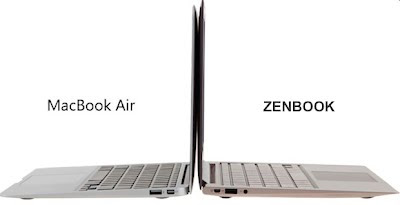
Apple MacBook Air Vs. Asus Zenbook Prime: Battle of Ivy Bridge-Powered Notebooks

Apple MacBook Air Vs. Asus Zenbook Prime: Battle of Ivy Bridge-Powered NotebooksNotebook computers have been attracting a fair amount of press in recent weeks, thanks largely to Apple’s new MacBook Pro, which is likely to be announced next month. However, the MacBook Air line is likely to undergo some changes, as is one of its top rivals – Asus’ Zenbook series of ultrabooks.

Some of the key features to be found on the new 13-inch Asus Zenbook Prime UX31A include a 1920 x 1080 in-plane switching HD display, backlit keyboard and solid-state drive options of 128 GB and 256 GB. Also expected on Asus’ new ultrabook is a revamped audio system courtesy of Bang and Olufsen and a new wireless network card that promises faster-than-ever WiFi connection speeds.

The aforementioned storage units both run on 6G SATA 3 speeds and most are expecting great things out of the HD matte display. The Asus Zenbook Prime reportedly weighs just 3 pounds, giving it an ever-so-slight edge over the current MacBook Air.

Apple, on the other hand, has long been mooting a price reduction for the new MacBook Air, which is likely due in the third quarter of the year. Tech and business blog site Digitimes reported that Apple might reduce the price of the MacBook Air from $999 to $799, a significant price reduction but probably timely, given Intel’s emphasis on the ultrabook market.

The new MacBook Air will likely boast its own improved display, thanks to Retina Display technology. However, not much else is known about this device at this point.

It will be an interesting battle of ultrabooks, though we may need a few more weeks before we glean more information on both devices, particularly the new MacBook Air.


Source: Easternmorningherald

Sunday, May 27, 2012

Ivy Bridge MacBook Pro 2012: “beats” Mac OS X Mountain Lion

Ivy Bridge MacBook Pro 2012: “beats” Mac OS X Mountain Lion Ahead of its possible June or July release date, Apple’s upcoming Mac OS X Mountain Lion is not the “much anticipated” feature of the new MacBook Pro, says the new poll. Intel’s Ivy Bridge Processors takes spotlight.

Sorry software fans, but Intel’s Ivy Bridge processor is reportedly the star of the next MacBook Pro, whether you like it or not.

According to MacWorld Australia’s unscientific poll, Intel’s new chipsets leads the unofficial popularity race of the rumored MacBook Pro features. With nearly 40 per cent of the poll’s respondents, it shows that customers are waiting for the new laptops because of Intel’s processors which are not “exclusives,” and are also present in other ecosystems, like the upcoming Windows 8 for example.

Apple’s software with the combination of the quad-core Intel chips could be the reason behind the landslide victory in the small poll, and apparently, the hardware, especially the processor, affects the overall performance of the desktop’s user interface.

One of the models of the new MacBook Pro is expected to include Intel’s Ivy Bridge Core i7-3820QM quad-core running at 2.7GHz, based on a leaked benchmark results.

According to BBC News, quoting an industry analyst, Intel will continue to lead the processor race. With the help of upcoming Windows 7 and 8 PC and laptops, and the possible MacBook Pro 2012, Intel will reportedly maintaining its slow growth until the release of its next-gen chipset, Haswell.

This year, Apple is expected to compete with at least a dozen new Windows laptop computers and ultrabooks with Intel’s chips, but according to the poll, at least 10 per cent of respondents are hoping for a bigger battery.

The most popular MacBook Pro rumor available online is the MacBook Air-like design rumor, reportedly without the optical drive, with a larger solid state drive, and possibly with the bigger battery, and 6.5 per cent of the poll participants said they want to see “that kind” of MacBook Pro, and if the rumor is correct, then the next-generation MacBook Pro laptops could be the lightest of its kind ever, beating previous versions that offered the large and heavy optical drive.

Liquidmetal, the rumored technology of the upcoming computers, is also a popular feature, the new poll revealed. However, some experts believe that this year’s MacBook Pros will not include Liquidmetal technologies on its cases.

Surprisingly, at least for me, is the lack of anticipation on the next version of the Mac OS X, the Mountain Lion. Apple is expected to distribute the new software with iOS-like features via its Mac App Store beginning this summer, and if the new MacBook Pro will hit stores next month, then it is expected to ship with the new OS X 10.8 pre-installed.

One analyst told a stock market-centric news agency this month that Q2, or the second quarter of this year, is the Mac-quarter and the next line of Apple laptops will attract more customers than other PCs running the open platform Windows. But next quarter, Apple will face rivals with Redmond’s new operating system, Windows 8, an OS that is trying to hit two birds using one stone–the two birds: the Mac and the iPad.

I should note that iPad is attracting more customers than MacBook Pros, and the price and portability of the tablet PC drive sales, says experts. Also last quarter, the new iPad 3 introduced LTE or Long Term Evolution making it the first Apple product with such feature that offers faster data uploads and downloads. One analyst said the 4G LTE, at least in the United States, was the product’s key feature.

So, what will be the key feature of the new MacBook Pro?

Source: Popherald

Tuesday, May 22, 2012

Apple MacBook Air vs MacBook Pro

Apple MacBook Air vs MacBook ProMost manufacturers would be happy enough to have the top-selling laptop at retail; to also have the laptop that a whole category of systems is chasing might seem like overkill. But that's the happy situation in which Apple finds itself, with the MacBook Pro 13-inch putting up blockbuster sales figures while the MacBook Air 13-inch is taped to the dartboards of ultrabook vendors from HP to Dell, from Asus to Samsung.

While there's inevitably gossip about a single, slim-but-powerful Apple laptop that would split the difference between the two product lines, for now mobile Mac buyers have to choose sides, ultra-slim Air or powerful Pro. Which is better for you?

Apple's offerings span the spectrum of laptop computing, from the 2.4-pound MacBook Air 11-inch (Best Deal: $999.00 at Woodwind & Brasswind) at $999—really $1,199 since, as efficient as OS X is, we still think you'll be happier if you double the base model's skimpy 2GB of RAM and 64GB of solid-state storage—to the 6.6-pound MacBook Pro 17-inch at $2,499. Processing power ranges from the dual-core Intel Core i5 CPUs of the Airs to the quad-core Core i7s of the desktop replacement Pros.

The two lines overlap at the 13-inch screen size, with the MacBook Air offered in 11- and 13-inch and the MacBook Pro in 13-, 15-, and 17-inch flavors.

Each model features unibody chassis construction, machined out of a single piece of aluminum, and is packed with Apple's trademark technology—from Thunderbolt ports and FaceTime video chat cameras to the MagSafe breakaway power connector that won't yank the laptop off your desk if you trip over the cord.

The MacBook Air, despite its more sophisticated (and expensive) flash storage, is positioned as the company's entry-level or everyday notebook, light enough to go wherever you go and handy enough for any job that crops up, while the Pro is a more performance-oriented platform for power users of specific applications.
At the extremes, the choice is easy. The MacBook Air 11-inch is all about ultraportability, a take-it-anywhere note-taker or light-duty productivity partner, while Apple refers to the luggable MacBook Pro 17-inch as "the ultimate mobile studio" (preferring not to use the word "workstation") for media professionals or enthusiasts in video or music editing or publishing.

The MacBook Pro 15-inch (Best Deal: $1,689.99 at MacConnection) has a fairly well-defined niche, too, as Apple's primary desktop replacement—light enough (5.6 pounds) that someone might at least occasionally take it on a plane or to the conference room to give a presentation, but muscular enough to tackle Final Cut Pro as well as Microsoft Office.
That leaves the tough Air-or-Pro decision to the 13-inch (actually 13.3-inch) segment, where the $1,199 MacBook Pro and $1,299 MacBook Air go toe to toe.

The Pro has more horsepower, with a 2.4GHz versus 1.7GHz Core i5 processor, and much more storage space, with a 500GB hard drive versus a 128GB SSD. While both have Thunderbolt and USB 2.0 ports, the Pro's thicker (1.0 versus 0.7 inch) chassis makes room for an optical drive—a slot-loading DVD±RW burner—and Ethernet port, two features not found in the Air.

But who needs Ethernet in this age of Wi-Fi? Who needs an optical drive in this age of app stores, movie downloads, and iCloud? The Air's snappy SSD gives it a responsiveness edge that almost equals the Pro's extra processing power, and besides, most people aren't going to be running Photoshop on a 13-inch screen (and if they are, the Air's 1,440 by 900 resolution tops the Pro's 1,280 by 800).

Most of all, while the MacBook Pro 13-inch is no bruiser at 4.5 pounds, you'll definitely feel the difference in your briefcase compared to the 3.0-pound Air. Mobile computing is all about, well, mobility, and we vote for the extra portability of the MacBook Air.

Source: PCmag

Monday, May 14, 2012

Intel Ivy Bridge iMac and MacBook Pro revealed in benchmarks


As we edge ever closer to June, more and more signs keep cropping up that Apple is poised to refresh its line of iMacs and Macbook Pros with Intel’s new Ivy Bridge chips. The latest tip comes from benchmarks posted to GeekBench with new iMac and Macbook Pro models featuring the new platform, providing detailed scores compared to old models, plus an idea of what processors we can expect to see.

The first entry on GeekBench is for the iMac13,2, which Cult of Mac believes corresponds to a 27-inch model featuring a quad-core Intel i7-3770 clocked at 3.4Ghz. The new iMac received a score of 12,182, coming in slightly higher than current Sandy Bridge models which score around 11,500. GeekBench also holds benchmarks for a new 13-inch MacBook Pro running an internal version of Mountain Lion and an Intel i7-3820QM running at 2.7Ghz. Benchmarks of Ivy Bridge chips have showed a 10-15% increase over Sandy Bridge chips, although Intel’s integrated graphics have also seen a big boost.

The HD 4000 shows a 20 to 100% improvement over the HD 3000 found in the Macbook Air and Macbook Pros depending on the scenario. Rumors have indicated that the upcoming 15-inch MacBook Pro would receive an Air-esque variant, dropping the optical drive and slimming down the chassis. High resolution icons found in Lion and Mountain Lion have also pointed towards high-resolution displays for the Macbook Pros. Stock levels for the current 15-inch MacBook Pro are also low, a tell-tale sign that a refresh is on the horizon. Source: Slashgear

Sunday, May 13, 2012

Apple Readies OS X for Retina Display MacBooks

Apple Readies OS X for Retina Display  MacBooksApple has been preparing its operating systems for high resolution Macs, adding evidence to the rumor that the next generation line-up of MacBooks will have Retina displays.

The OS X 10.7.4 update recently released by Apple was hiding some changes that may seem minor at first glance, but could indicate that Apple is about to launch something major.

Apple Insider reports that Apple's built-in TextEdit application's icon's highest quality version has been increased to 1024-by-1024 pixels, double that of the previous 512-by-512 pixels in the icon before the update. The increase in pixels readies the icon for a Retina display.

The file size of the icon also grew from 209 kilobytes in OS X 10.7.3 to 1.7 megabytes in 10.7.4, reveals the report.

This could this mean that Apple's new MacBook line-up, which is expected to arrive within weeks, will feature Retina displays like the one found on the new iPad, which has 3.1 million pixels, a million more than a HDTV.

Apple describes a Retina display as having pixels that are "so close together, your eyes can't discern individual ones at a normal viewing distance."

When Apple launched the beta of OS X 10.7 Lion, the App Store icon and the Launchpad icon were increased to 1024-by-1024 pixels, and in February, some cursers were improved to a higher resolution.

In April, Intel revealed that its new Ivy Bridge processers have been built for Retina display, which also indicates that Apple will launch Retina display MacBooks, as the company is expected to be the first to use the new chips in its products. The Ivy Bridge processor could power 2560-by-1600 displays, which is an impressive four times the amount of pixels currently found in the 13-inch MacBook Pro's display.

When testing OS X Mountain Lion, which is predicted to launch in June at Apple's WWDC in San Francisco, developers have also found double-resolution icons.

Source: Pcworld

Tuesday, May 08, 2012

2012 Macbook Air may battle Ivy Bridge Ultrabooks with price cut

2012 Macbook Air may battle Ivy Bridge Ultrabooks with price cutApple may not be talking about concerns over competition between their 13-inch Macbook Air and 2012 Ivy Bridge Ultrabooks, but that doesn't mean they are ignoring the threat either. In fact, Apple is taking it so seriously, there is already speculation that the next generation of Macbook Air's will emerge with a price cut.

"Apple's plans are reportedly to counter second-generation Ultrabooks, based on Intel's specifications for thin and light notebooks, which PC makers hope to price around $699," according to Apple Insider.

"If PC makers are unable to reach the $699 price point with their second-generation Ultrabooks, Apple could have a significant competitive advantage with an aggressive $799 price point for a new MacBook Air."

So, could Apple really be ready to think the unthinkable and cut the price of the next generation Macbook Air?

Ultrabooks have come a long way since their introduction behind the 2008 Macbook Air, and Ivy Bridge Ultrabooks could still pose a threat to the 2012 Macbook Air, even with a price cut.
There is a lot at stake for Intel this year. Their branding for the Ultrabook could shape the future of PC's as true performers, or give Apple yet another success story, proving they know how to eat the competition.

2012 is being touted as the Year of the Ultrabook. That means that in the world of laptops, Ultrabooks will either emerge as viable competitors, or Apple will corner the 13-inch laptop market and leave the 2012 Ultrabooks in the dust.

Portable computing has also become a battle of operating systems, with Apple boasting less susceptibility to internet viruses than PC's. But there is yet another factor working in Apple's favor. With the growing number of iPhones and iPads on the planet, compatibly could push some potential Ultrabook buyers toward the Macbook Air. Apple products would much rather 'talk' to other Apple products, thus making syncing between devices even more convenient.

Apple seems to be banking on their new strategy with their 13-inch line. In addition to rumors of a price cut for the next generation of Macbook Air's, orders for the 13-inch 2012 Macbook Pro are far exceeding 15-inch models, according to Digitimes, which suggest that Apple may be getting ready for a big push of their best-selling,13-inch Macbook Pro line as well.

If you follow the supply chain and production lines with Apple, it is easy to see their vision for the future, although tracking is not really required. Apple has made no secret of the fact that they want consumers to think of only one name when it comes to technology, and that name is Apple.


Source: Allvoices